

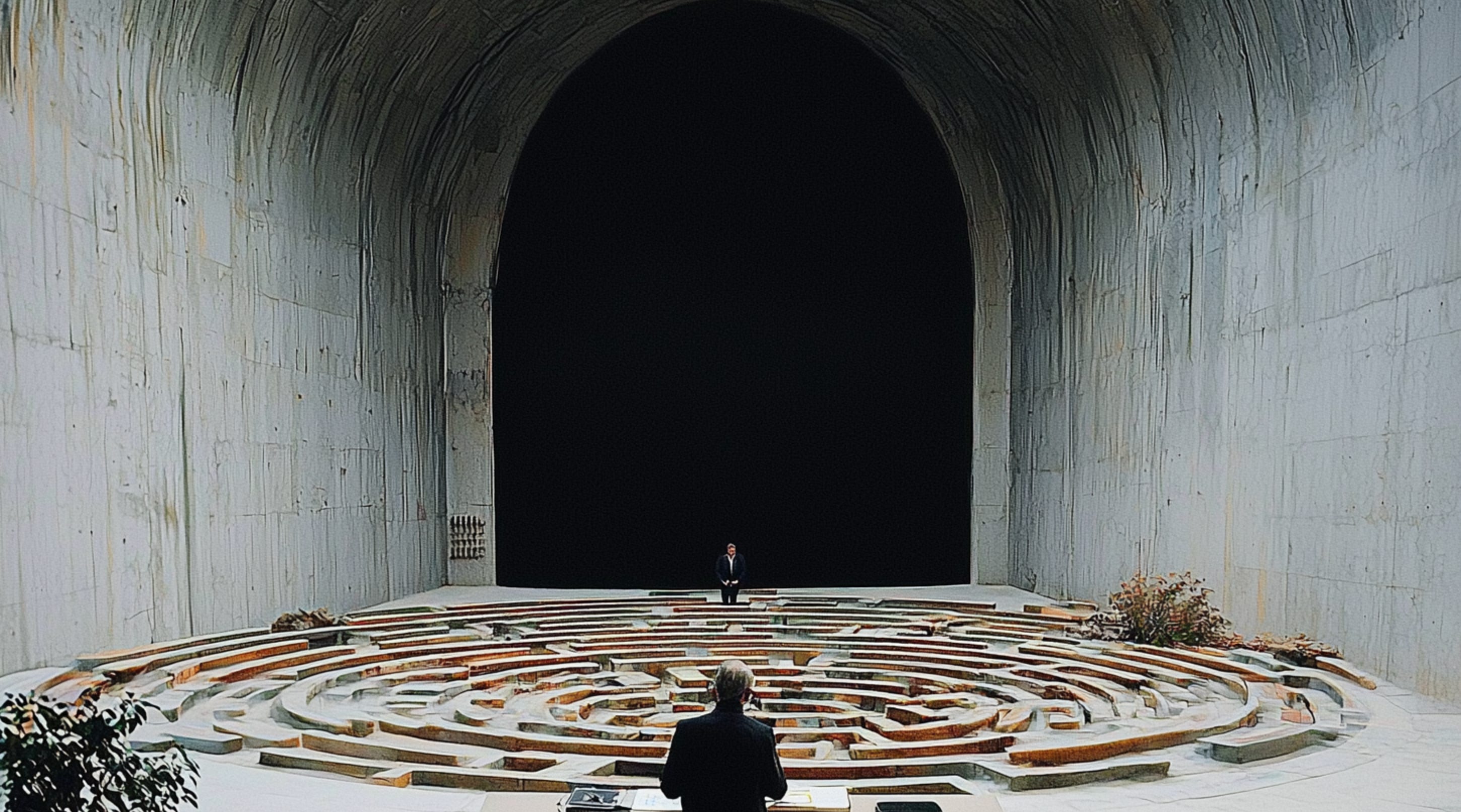
Modern culture is focused exclusively on questions that can be answered quickly.
In academia, that’s what you can get funding for. Fast questions can be answered within a few weeks. You can then publish a paper. You can start collecting citations. You can present your answer at conferences. This is how you build a career.
But the most important questions can’t be answered like that.
When you can write down a step-by-step plan for how you’re going to answer a question or solve a specific problem, you aren’t doing research but development.
Research means you only have a fuzzy idea of your destination but no clear idea of how you’re going to get there. You’re mostly just following hunches and intuitions. That’s how the biggest leaps forward are achieved.
Development is the execution of a map toward a goal while research is the pursuit of a goal without a map.
Working on questions you can answer fast means you know what you’re doing. And knowing what you’re doing is a sign you’re not pushing into genuinely new territory.
Slowness allows for the exploration of uncharted territory and unexpected discoveries. Johann Friedrich Böttger spent almost a decade trying to find a formula that produces gold. While he never succeeded, a byproduct of his relentless experimentation was the discovery of a process to produce porcelain.
Andrew Wiles worked in secret for 7 years on Fermat’s Last Theorem, publishing nothing. It took Einstein around ten years to write down the foundational equation of General Relativity.
In this sense, when it comes to research, speed should be considered an anti-signal and slowness a virtue.1
How Intelligence Leads Us Astray
Our very definition of intelligence encodes the bias toward speed. The modern definition of intelligence is extremely narrow. It simply describes the speed at which you can solve well-defined problems.
Consider this: if you get access to an IQ test weeks in advance, you could slowly work through all the problems and memorize the solutions. The test would then score you as a genius. This reveals what IQ tests actually measure. It’s not whether you can solve problems, but how fast you solve them.
And it’s exclusively this kind of intelligence that’s measured in academic and IQ tests.
What these tests completely miss is the ability to select problems worth working on and to choose interesting steps forward in the absence of a well-defined problem.
As a result, many people live under the illusion that because their intelligence doesn’t fit this narrow definition, they’re not able to contribute something meaningful.
As the saying goes, “if you judge a fish by its ability to climb a tree, it will live its whole life believing that it is stupid”.
So where does this obsession with IQ come from? Partly from bad science that got repeated until it became truth. In the 1950s, a Harvard professor named Anne Roe claimed to have measured the IQs of Nobel Prize winners, reporting a median of 166. The finding has been cited ever since. But here’s what actually happened: she never used a real IQ test. She made up her own test from SAT questions, had no comparison group, and when the Nobel laureates took it, they scored... average. Not genius-level. Just fine. She then performed a mysterious statistical conversion to arrive at 166. The raw data showed nothing exceptional. But the inflated number is what survived.
Einstein never took an IQ test, but his school records show a B+ student who failed his college entrance exam on the first try. The numbers you see cited are invented. And the few geniuses we do have data on, like Richard Feynman, scored a “mere” 125.
In fact, it’s not hard to imagine how raw processing speed can be counterproductive. People who excel at quickly solving well-defined problems tend to gravitate toward... well-defined problems. They choose what to work on based on what they’re good at, not necessarily what’s worth doing.
Consider Marilyn vos Savant, listed in the Guinness Book of World Records for the highest recorded IQ. What does she do with it? She writes a puzzle column for Parade magazine.
Slow thinkers, on the other hand, have an easier time ignoring legible problems. They’re not constantly tempted by technical puzzles they know they could solve.2
The obsession with processing speed creates a systemic filter. Because we measure intelligence by how quickly one can reach a known finish line, we exclusively fund the ‘sprinters.’ But if you are a sprinter, you have no incentive to wander into the trackless wilderness of true research where speed is irrelevant because the direction is unknown.
At the same time, ‘sprinters’ rise to leadership and design institutions that reward the same legibility they excel at. Over time, our institutions have become nothing but a series of well-manicured running tracks. By rewarding those who can write down and finish well-explained plans the fastest, we have built a world that has no room for anyone who doesn’t yet have a plan.
Illegibility
Legibility and speed are connected. Well-defined problems come with clear milestones, measurable progress, and recognizable success. They’re easy to explain to funding committees, to put on a CV, to defend in casual conversations.
But, as Michael Nielsen put it: “the most significant creative work is illegible to existing institutions, and so almost unfundable. There is a grain of truth to Groucho’s Law: you should never work on any project for which you can get funding.”
Because if it’s fundable, it means the path is already clear enough that it will happen anyway. You’re not needed there.
Many people abandon interesting problems because they don’t know how to defend them and how to lay out a legible path forward. When someone asks “what are you working on?” they need an answer that immediately makes sense. When people ask “how’s it going?” they need visible progress to report. The illegible path offers neither. So most people switch to something they can explain.
And this is how modern institutions crush slow thinkers. Through thousand small moments the illegible path becomes socially unbearable.3
So here is a question worth sitting with: What problem would you work on if you could delete “legible progress within the next ten years” from your list of requirements?
When you’re doing development, on the other hand, slowness should be called out and criticised. It is right to ask why so many development projects take so much longer compared to similar projects in the past.
My mom likes to make fun of me for thinking slowly. She’s not wrong. It’s why I’m boring in conversations and prefer writing, where I can take my time. School almost crushed me until I realized there is no free lunch in either direction and every weakness is a strength. Slow thinking gives you the patience to sit with ambigious problems that don’t have obvious answers.
Many people know that I don’t like talking about what I’m working on. This is a big reason why. I don’t want to waste any energy defending illegible ideas. The other reason is that talking about plans tricks the brain into feeling like you’ve already made progress. The satisfaction you get from explaining your vision can quickly replace the drive to actually execute it.
I resonate with this. The nature of fast for the sake of fast ignores exploring the fog of war for true breakthroughs.
Hi Jakob,
Brilliant article as always. What startles me is how true your observations are even with respect to the Indian education system, particularly of engineering entrance examinations like the J.E.E; which is confounding because in eastern thought one gets lifetimes in pursuit of an 'ill-defined' goal as part of his/ her process of self-discovery. Perhaps India is no longer what it used to be.
Your observations also ring true when applied to sports in general. Take chess for example : nowadays people get trained in chess tactics, that is they memorize thousands of combinations which greats of previous generations created. There is hardly anything they do in their play that can be termed as truly original. This also explains why hardly anyone plays the long format anymore. The intoxicated high of winning trumps all subtler sensibilities.
Perhaps society on the whole has geared itself in a direction in which no one recognises the worth of slow thinking and what it can accomplish. We live so far away from Nature that we have forgotten to appreciate how slowly and over what timescales Nature herself works. We see ourselves in opposition to Nature and not as a part of Nature anymore.
Two books come to mind - ' Zen in the art of archery' by Eugen Herrigel and ' Small is beautiful' by Dr E.F Schumacher that explore similar ideas.
- Sayan Datta (Kolkata, West Bengal)