

Asking whether the wave function is “real” is a bit like asking whether verbs are “real” in a language. It confuses a feature of the description with a feature of the thing being described.
Far too many debates in the foundations of physics have this flavor. People mix up the vocabulary (primitives), the grammar (constraints), the dialect (formulation), and the meaning (interpretation).
Keeping these four levels separate makes it obvious that a lot of arguments are really just category errors. What's left are the questions worth spending time on.
Constraints and Primitives
When we want to describe nature we need to clarify what primitives and what fundamental constraints we are going to use.
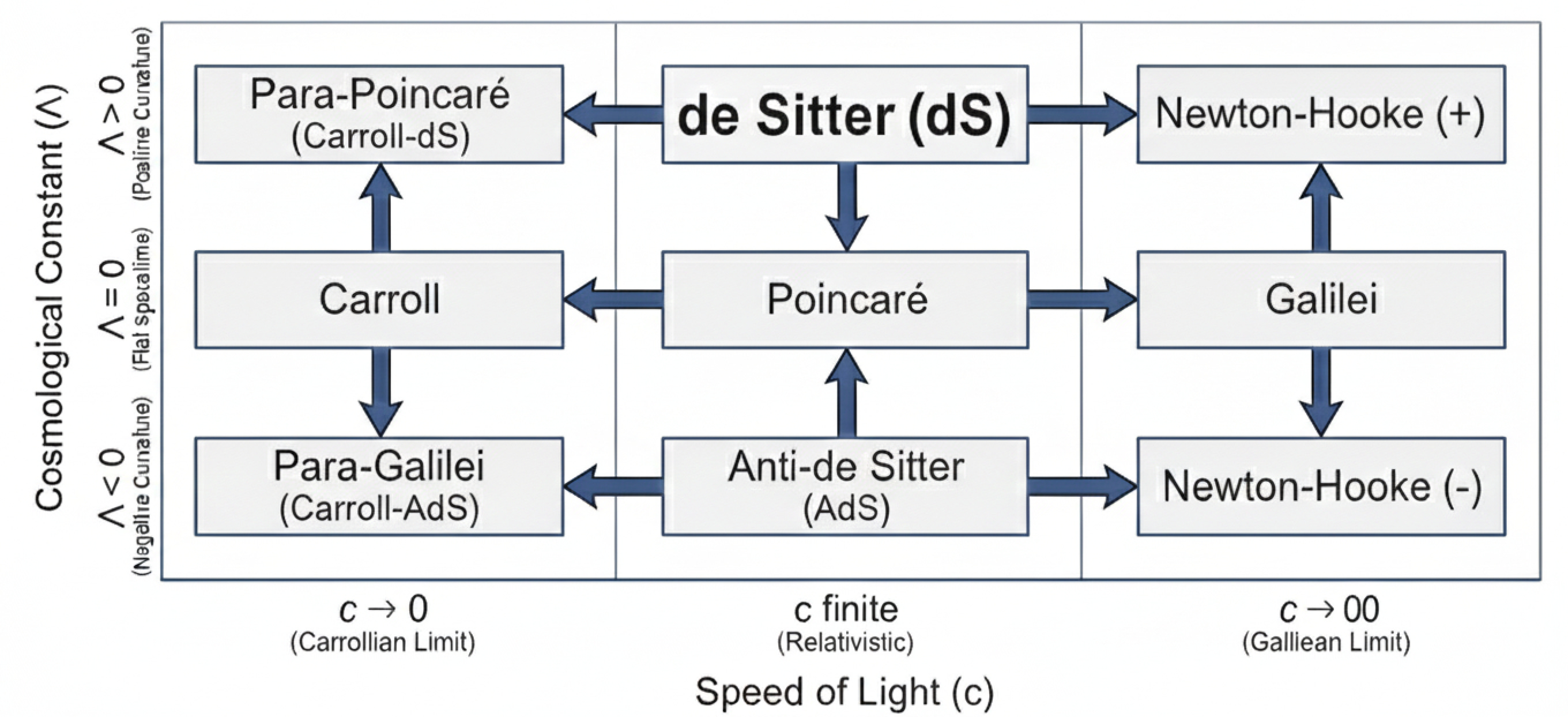
One fundamental constraint, for example, is whether or not there is an upper speed limit. This is commonly encoded by the speed of light c being non-zero or infinity.
Another possible fundamental constraint is whether or not there is a fundamental minimum action (in the technical sense of the Lagrangian formalism).1 This is encoded by the Planck constant h being non-zero or zero.2
A third fundamental constraint is whether or not there is a minimum realizable energy density for empty space. This is encoded by the value of the cosmological constant Λ.
A useful way to understand many constraints is using the language of symmetry. A symmetry tells us what remains unchanged under what set of transformations. The speed of light constraint implies the correct spacetime symmetry group is not the Galilei group but the Poincaré group. The non-zero observed cosmological constant Λ implies that the correct kinematical group is the de Sitter group.
Similarly, we now know that fundamental interactions are governed by “internal” symmetry groups that we call U(1), SU(2), and SU(3).
On the other hand, the most common primitives are:3
Particles, which are localized at a single point
Fields, which aren’t localized at all, meaning instead of at a single point they are everywhere.
Note that we only decide here what the fundamental ingredients are, not what’s allowed to exist. Particles can emerge as excitations of fields. Fields can emerge as effective structures from particles if we zoom out.
Now, if we take particles as primitives, we end up with the following frameworks:4

If, on the other hand we consider fields as primitives, we get:

You can also have frameworks where both, fields and point particles, are fundamental like in Maxwell’s theory of electromagnetism.
This is all straightforward, and there is nothing controversial about this. We know from experiments that there is an upper speed limit and a minimum limit of the action. Hence, relativistic quantum theories are our best frameworks to describe nature at fundamental scales.
The other frameworks, on the other hand, can still be tremendously useful in cases where we can safely ignore these constraints. For example, when all the velocities are far below the speed of light, the upper speed limit has no meaningful impact, and we can use a non-relativistic framework.
Formulations
“If God is a mathematician, in what dialect does She/He/They/It speak?” - John Horgan
Where things do get a bit more tricky is when it comes to the choice of mathematical arena.
It turns out that you can describe each framework in a multitude of different mathematical arenas. Well-established arenas include Hilbert space, phase space, configuration space, or real space.
For example, the Hilbert space formulation of Classical Particle Theory is known as Koopman-von Neumann Mechanics while the configuration space formulation is known as Lagrangian Mechanics. The phase space formulation is Hamiltonian Mechanics. On the quantum side, we call, for example, the configuration space formulation Path Integral Formulation.
Each formulation is mathematically equivalent within a given framework. They make identical predictions for all physical observables. The choice between them is therefore not a matter of which is “correct” but rather which is most convenient or insightful for a particular problem.
For instance, Hamiltonian mechanics makes conservation laws transparent through Noether’s theorem, while Lagrangian mechanics often simplifies problems with constraints.
Looked at from this perspective, Bohmian mechanics is simply the real space formulation of non-relativistic quantum particle theory. Just as you can write classical mechanics in phase space (Hamiltonian) or configuration space (Lagrangian) or real space (Newtonian), you can write quantum particle theory in Hilbert space (standard textbook quantum mechanics) or real space (Bohmian mechanics).
Yet people routinely make a category error here. They treat Bohmian mechanics as if it were a competing theory rather than an alternative formulation. Then they argue that Bohmian mechanics is “disproven” or “fails” because no relativistic quantum field theory version has been successfully developed. But this gets things backwards. The lack of a fully worked-out relativistic field theory extension is not evidence against Bohmian mechanics as a formulation. It simply means the mathematical work hasn’t been completed yet.
Now importantly, I’m not claiming that Bohmian mechanics is superior as some Bohmian enthusiasts do. It’s simply a different formulation. Every formulation has trade-offs.
Consider an analogy: nobody bothers to work out Koopman-von Neumann mechanics (the Hilbert space formulation of classical particle theory) for complicated systems. Why would you? The phase space and configuration space formulations are far more useful for most practical purposes. But the absence of detailed Koopman-von Neumann treatments for most systems doesn’t mean the formulation “fails.” It just means nobody has bothered.
You can certainly argue about practical benefits of different formulations but this is an entirely separate discussion from questions about physical truth. The Hamiltonian formulation isn’t “more true” than the Lagrangian formulation or the Newtonian formulation.

“Every theoretical physicist who is any good knows six or seven different theoretical representations for exactly the same physics. He knows that they are all equivalent, and that nobody is ever going to be able to decide which one is right at that level, but he keeps them in his head, hoping that they will give him different ideas for guessing.” - Richard Feynman
Interpretations
Most discussions about interpretations similarly miss the point like discussions about formulations.
For example, the wave function is a mathematical object that appears in the Hilbert space formulation. It doesn’t appear in the path integral formulation. It doesn’t appear in Bohmian mechanics. Asking whether the wave function is “real” is like asking whether Hamiltonians are “real”. It’s treating a formulation-specific tool as if it were a fundamental feature of nature.
There’s little to learn from arguing about the reality of mathematical tools that only appear in certain formulations.
At the same time, I’m certainly not against having discussions on interpretive issues in physics. Just not these kinds of discussions.
Discussions Worth Having
“Everything not forbidden is compulsory.” - Murray Gell-Mann
What I like about the meta-framework outlined above is that makes it clear what areas are rarely explored and underdiscussed. It’s a useful lens to find questions worth asking.
Meaning of the Constraints
The fundamental constraints govern everything downstream. So if there are interpretative questions worth discussing it’s:
What do these fundamental constraints mean?
Where do these fundamental constraints come from?
The answer to the first question in the case of the speed of light limit might seem obvious but that doesn’t make it any less mysterious. How does it show up in different formulations? Are there any alternative interpretations that cast a different light on it?
Especially when we start adding quantum dynamics into the mix, questions of, for example,“locality” start to become a lot less obvious. Expressing the non-zero Planck constant constraint in terms of a minimal action or minimal phase space resolution does help but it’s far from what I would call satisfying interpretation. The same goes for interpreting the cosmological constant in terms of minimum realizable energy density for empty space.
Phase space is pixelated like a blurry jpg. Spacetime causality is bandwidth-limited. The universe has a lowest-frequency mode (or non-zero “idling” energy). But why?
Just as mysterious are the constraints that we are currently only able to articulate in terms of “internal symmetries”. Why exactly does the U(1), SU(2), SU(3) “gauge argument” work so spectacularly well in describing fundamental interactions?
Developing any ideas where these constraints come from would mean a huge step forward.
To give just a few quick ideas what this might look like:
If we assume spacetime is discrete and no jumping on our spacetime grid is allowed, we automatically get an upper speed limit. That is no proof that spacetime is discrete, of course. But it’s an interesting, alternative perspective on how a constraint like this might arise.
In the QBism interpretation of quantum mechanics, the non-zero Planck constant is understood as a “kind of coupling constant between subject and object” and hence quantum and classical theories “differ only in how they treat the subject-object relation”.
In a “computational” interpretation, the cosmological constant Λ is the Garbage Collection boundary. While the speed of light (c) limits the latency of a single calculation and the Planck constant (h) defines the bit-depth of the data, Λ defines the Total Addressable Memory (RAM). By accelerating the expansion of space, the universe creates a “Cosmological Horizon” that effectively deletes distant, unreachable data from an observer’s local “cache.” Λ is the mechanism that ensures the simulation remains locally finite, preventing the system from choking on the infinite data of an infinite, static universe.
Internal symmetries can be understood as remnants of bigger symmetries that spontaneously broke when the universe cooled down. This is a popular idea known as Grand Unification. However, it of course only pushes the real puzzle further down the line. Where do these “internal symmetries” come from and why exactly these symmetries instead of the infinitely many others possible? One approach is to derive internal symmetries from the structure of spacetime as in the Kaluza-Klein theory. However if the way this happens isn’t forced on us by the theory but something we put in, I’m not sure how much we are actually learning here. (Meaning if there are ways to get basically any possible group out of the process in principle and we are putting in a specific “compactification” scheme to get just the groups we need.)
Different Constraints and Primitives
Nature always creates the best of all options. - Aristotle
In a recent essay I’ve outlined the “Games Mathematicians Play”: classifying all the things that can be classified and thinking through all the ways assumptions can be dropped.
In other words, a fruitful approach is often to explore all the different universes we can find a consistent description for. Even if there is currently no experimental evidence that we inhabit such an alternative universe, that doesn’t mean we aren’t living in one. The Planck, cosmological, and speed of light constraints, just like the shape of our planet or its place in the solar system, are far from obvious until you know where to look.
In our framework here this would mean asking questions like:
What constraints that are on the same fundamental level as the speed of light, the Planck constant, and the cosmological constant could theoretically be added? So far, physicists only added these constraints when they were forced on us by experiments. But maybe there is a chance to get ahead of experimental discovery by exploring other possible constraints systematically.5
What other primitives can we use? There is a whole spectrum of primitives that live somewhere between the two extremal cases of point particles and fields. The best known example is strings that are localized on a line instead of a single point. What if we use them without the ambitious idea to use them to unify everything and get rid of point particles?
What modifications of spacetime are possible? What if it is discrete vs. continuous, curved instead of flat, a dynamic actor instead of a passive background structure, and what is its dimensionality? A lot of research has, of course, already been done on these questions but typically only within specific frameworks that come with a lot of extra baggage. Another lesser-known example: What if our usual abstraction using real numbers to label space and time is too idealistic? What would be the alternatives? (After all, if you take this abstraction seriously, you quickly run into paradoxes.)6
Dualities and Emergent Primitives
“The opposite of a good idea can also be a good idea”- Rory Sutherland
What if some primitives are not actually fundamental but emergent? How far can we push this idea?
In fact, a popular view is that fields are fundamental and particles only emerge as field excitations. If you want to be dramatic, you could say, “there are no particles, there are only fields”. Now fields are undeniably extremely powerful bookkeeping devices in situations where we are dealing with particle creation and annihilation like for example collider experiments. But then again, usefulness doesn’t mean it’s true.
So what about the exact opposite idea that particles are fundamental and fields are emergent structures?
Even more radical is the idea that we drop spacetime as a primitive. Can we build a consistent framework where spacetime with all experimentally known features emerges purely through the relations of the other primitives?7
And what about the opposite idea here? What if there is only spacetime and no other primitives? Particles or fields would need to arise purely from geometric features of spacetime. There is, of course, a good example of this already: General Relativity is able to explain gravity through spacetime curvature. Theodor Kaluza showed a hundred years ago that by extending spacetime to five dimensions, one could produce the Einstein equations in four dimensions, plus an extra set of equations that is equivalent to Maxwell’s equations for electromagnetism. Albert Einstein spent decades trying to make ideas like this work.
There are also ideas for how to understand internal symmetries as emergent.
Different Arenas and Formulations
The important thing in science is not so much to obtain new facts as to discover new ways of thinking about them. - William Lawrence Bragg
Last but not least, the history of science shows that alternative formulations have tremendous value in casting fresh light on old problems.
So, what other formulations of our theories are possible? What other mathematical arenas are worth using?
We know that besides real and complex numbers there are only two additional consistent number systems: quaternions and octonions. So what about formulations in quaternionic or octonionic Hilbert spaces?8
Another interesting alternative mathematical arena to explore is Twistor space.
There’s no reason to think we’ve exhausted the possibilities. Hamiltonian mechanics wasn’t developed until fifty years after Lagrangian mechanics. The path integral formulation of quantum mechanics came decades after the Hilbert space formulation. Each new formulation brings not just mathematical convenience but genuine conceptual insight.
In summary, the framework I’ve sketched here is really just an invitation to be more careful about what level we’re actually arguing about.
Most debates in foundations of physics go nowhere because people are talking past each other or are having arguments like people discussing their favorite sports teams.
Once you see the distinctions clearly, you realize that many “deep” disagreements are actually just category errors, while the most interesting questions remain wide open and largely unexplored.
Thinking about what this actually means in intuitive terms is one of the most interesting topics in physics and gets right to the heart of interpreting quantum theories.
On top of that, we have universal constraints like that the physics is the same in all inertial frames of reference that are usually not played with.
The “inner structure” of these primitives is determined by the choice of constraints. This is how we end up with labels like spin. There is a deep reason why we are confident to treat these labels as fundamental based on symmetry arguments. This is one of the main points in my book Physics from Symmetry.
Theories in de Sitter space (universes with non-zero cosmological constant) are curiously underexplored so far.
The canonical paper on this topic is Possible Kinematics by Henri Bacry and Jean‐Marc Lévy‐Leblond. In a sense, the non-zero cosmological constant could have been predicted much earlier from symmetry considerations.
To learn more about this look into Intuitionist Mathematics.
Frameworks where spacetime is not a primitive but emergent are commonly known as “relational theories.”
There has been some work on quaternionic quantum mechanics.
Dear Jakob,
Thank you for your interesting thoughts. I'm thinking a lot about the accuracy of the notions used; for the time being, equal versus identical particles. IMHO, this is related to your thoughts. Are you interested in this issue?
Thank you and best wishes, Peter
Relational complexity forming time and the relational differences providing the degrees of freedom and relativistic effects we experience as classicality. Quantum fields as a post-projection artifact of a deeper, richer substrate. Gated projection criteria from that richer field.
That’s my guess anyway.