

I get asked which quantum mechanics book to start with more than any other question. I wrote one of the candidates, so take my ranking with that in mind. I put my own book first because I wrote it for exactly this reader: someone learning alone, without a lecturer to ask when a derivation jumps. If you’d rather not trust me on that, the other four are all books I’d recommend anyway, and the reading order at the end works without mine.
My criterion is simple. Which book gets you from “I’ve heard of the Schrödinger equation” to solving problems with it, and understanding what it all means, if nobody is there to help?
1. No-Nonsense Quantum Mechanics (Jakob Schwichtenberg)
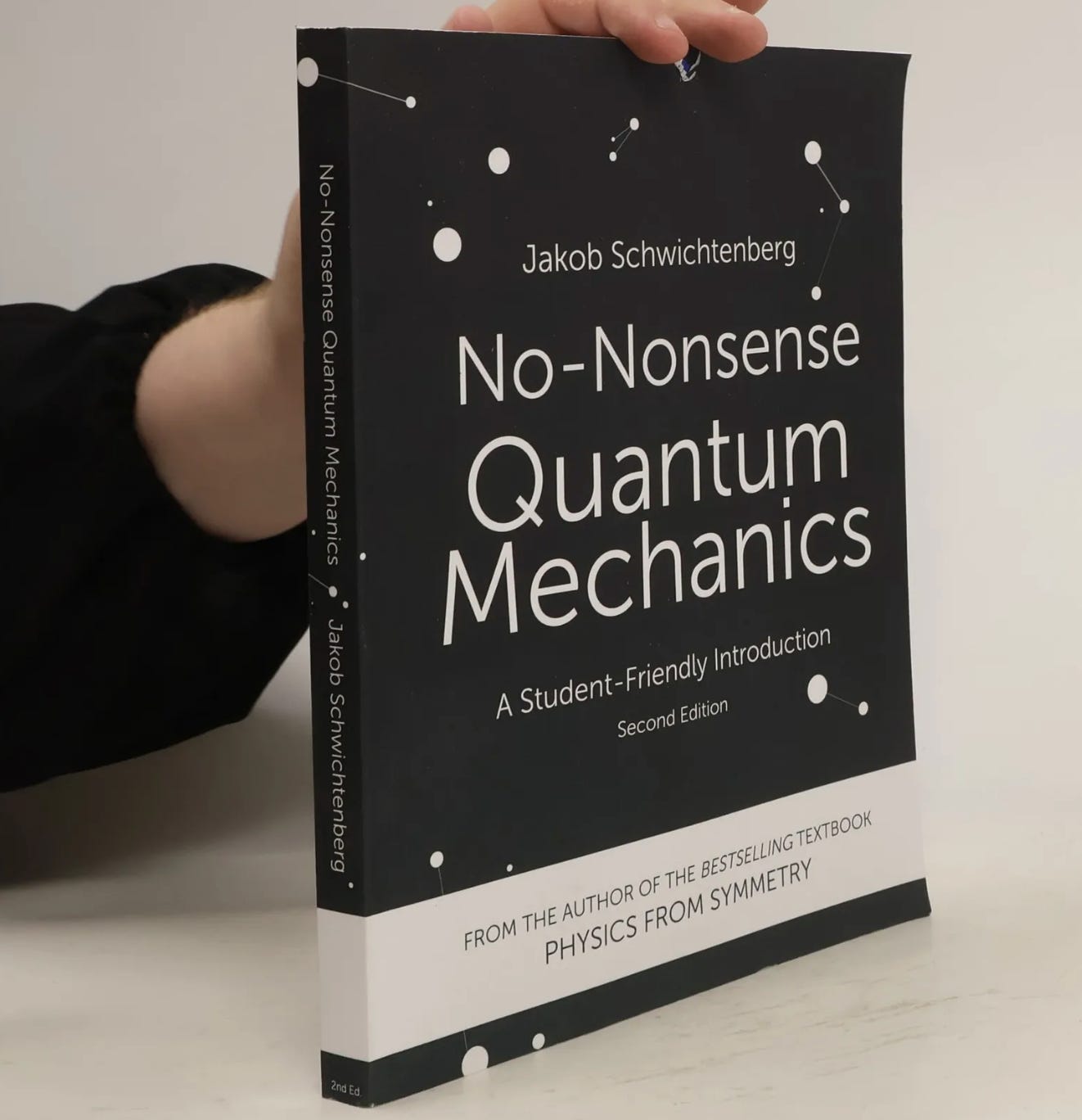
I wrote this one because the books I learned from kept skipping the steps I needed. A result would appear after “it can be shown that”, and I’d spend an evening reconstructing four lines of algebra the author considered obvious.
So the book does every derivation in full. When a calculation uses a trick, like inserting a complete set of states, I explain why that trick and not another one. Before introducing a piece of formalism, I try to say what problem it solves. The book covers the Schrödinger equation and the canonical commutation relations, works through the standard quantum systems step by step, and then has chapters on the alternative formulations and interpretations and how they connect to the wave function picture. There are appendices on the math you need (Taylor expansion, Fourier transform, delta distribution).
Where it falls short: it has no exercises unlike Griffiths or Zettili, and you need a lot of exercises to learn this subject.
Read it with pen and paper, redo each derivation yourself, and get your problems from the books below.
2. Introduction to Quantum Mechanics (David Griffiths and Darrell Schroeter)
If you take a university course on quantum mechanics, there’s a good chance this is the assigned book. The writing is clear, the problems are well chosen and get harder at a sensible pace, and Griffiths is funny in a dry way that helps on long chapters.
It was written for a course, and it shows. Steps get compressed because a lecturer is expected to fill them in. With a course, that’s fine. Alone, some of those gaps will cost you an evening each. I’d pair it with my book: mine for the derivations, Griffiths for the problem sets.
3. Quantum Mechanics: Concepts and Applications (Nouredine Zettili)
Zettili is full of worked examples and solved problems, more than any other book on this list. If you’ve read a chapter, followed every line, and then couldn’t start the first exercise, this is the book that fixes that.
One warning. Reading a worked solution feels like learning, but mostly it isn’t. Cover the solution, try the problem, get stuck, and only then read it.
4. Quantum Mechanics: The Theoretical Minimum (Leonard Susskind and Art Friedman)
Susskind starts with states, vectors and the logic of measurement rather than with the wave function. It’s short and conversational, and it gives the clearest picture I know of what the theory says. It grew out of his Stanford continuing education lectures, which are free on YouTube, so you can watch along.
It won’t teach you to calculate and won’t get you through an exam. I recommend it to people who keep losing the big picture while the math piles up.
5. Principles of Quantum Mechanics (R. Shankar)
Shankar is a graduate-level text that is unusually kind to self-learners. It opens with a long chapter on the mathematics and a review of classical mechanics, and then builds the formalism carefully, through Dirac notation, symmetries, angular momentum, the hydrogen atom and path integrals.
It’s a lot of work. I’d come to it after a first pass with one of the books above. At that point most of the formalism will already look familiar and Shankar shows you how it fits together.
The order I’d use
Don’t read five books at once. Pick one main book and one source of problems.
Main book: No-Nonsense Quantum Mechanics, or Griffiths if you’re taking a course.
Problems: Zettili for volume, Griffiths for quality. Do them by hand.
Susskind once, early, if the conceptual picture keeps slipping.
Shankar later, when you want the full graduate treatment.
Before any of this, check your linear algebra. Vector spaces, bases, eigenvalues, inner products and diagonalization need to be fluent. A lot of what looks strange in quantum mechanics is linear algebra you haven’t fully absorbed yet.
If you’ve read any of these and got stuck somewhere, reply and tell me where. It’s the most useful email I get, and it’s how I decide what to fix in the next edition.