

One of the quirks of the human mind is its strong tendency to create a sense of coherence.
For example, look at the objects below.
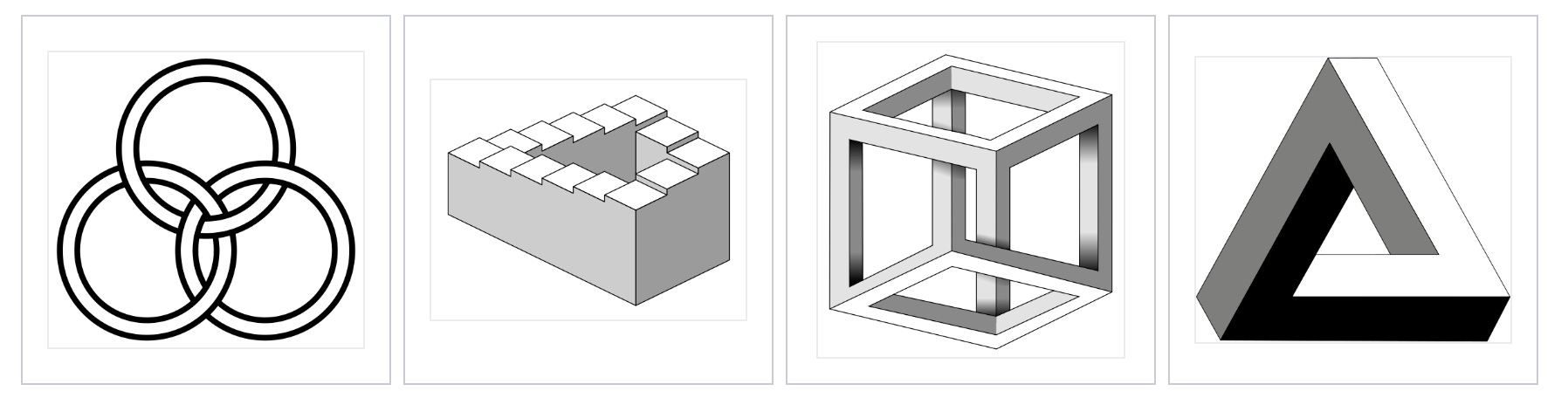
At first glance, there doesn’t seem to be anything wrong with them.
You have to force yourself to look closely, study each object’s details to notice that they don’t make any sense.
These are all impossible objects that cannot exist as three-dimensional objects.
Analogously, many assumptions in science are actually impossible assumptions.
They feel right and obviously make sense… until you actually look at them.
The Trouble with Absolute Time
One famous historical example of an impossible assumption is Newton’s absolute time.
The idea that time flows “uniformly without relation to anything external” feels intuitively right.
But there are deep, fundamental problems once you think it through.
First of all, note that Newton's absolute time bundles two assumptions.
Assumption 1 is that there is a universal “yardstick” we can use to measure time intervals.
What is that universal yardstick? How do you actually measure absolute time?
Newton, of course, thought about this. His answer was that absolute time is equal to sidereal time (encoding the rotation of the earth relative to the stars). Unlike solar time (encoding the rotation of the earth relative to the sun), it roughly agrees with time intervals measured by, for example, pendulum clocks.
But sidereal time isn’t uniform at all. The earth's rotation slows down due to tidal friction, and earthquakes and core motion introduce further wobbles.
Similarly, the beats of a pendulum have equal duration only in a first approximation. Temperature, air resistance, and gravitational effects of far-away stars inevitably introduce perturbations.
A modern answer would be that absolute time is equal to atomic time.
But atomic clocks also disagree with each other. The “atomic second” is actually a weighted average of hundreds of clocks worldwide, and the average shifts every time a clock is added, removed, or recalibrated. There is no single authoritative atomic clock to point to.
All chronometers have to be corrected from time to time.
So, when you say the hour from noon to 1pm lasted the same amount of time as the hour from 2pm to 3pm, what do you actually mean by that?
It feels obvious that we can compare time intervals just like that.
But you have no way of putting those two hours side by side to check that they are equal. You cannot reach into the past, pull the hours out, and lay them next to each other like two rulers.
We act like we can do this using clocks. But no clock is actually measuring that mythical absolute time. So how can we be sure that two time intervals are truly of the same length?
You might object that this is just an engineering problem. Our clocks are imperfect today, but ticking away in the background of the universe, there is a true absolute time that better instruments will get us closer to.
But think about what we actually do when we say a clock “needs correction.” We can never check it against absolute time. We check it against another clock. And what makes that other clock the standard?
As Henri Poincaré observed in his 1904 book The Value of Science: “We have no direct intuition of the equality of two intervals of time. Anyone who thinks they have this intuition is fooled by an illusion.”
Assumption 2 implicit in Newton’s absolute time is that there is an objective fact about whether events happened at the same time. Reality has a universal "now" that slices past from future identically for everyone, everywhere.
In 1572, the astronomer Tycho Brahe spotted a “new” star in the night sky. We now know that star was actually a supernova that had exploded thousands of years earlier. The light just took that long to reach us. So the explosion Brahe was watching had actually happened roughly when the inhabitants of Jericho were stacking the stones of what may be the oldest city wall on Earth.
Now ask yourself what that sentence even means. How would you ever check this? No observer ever could be present at these two events at the same time to conclude they definitely happened at the exact same time.
Or consider an observer sitting in a spaceship that moves with constant velocity away from earth towards the supernova?1
Passengers in this spaceship would actually see the supernova explode years before the Jericho wall went up.
Once again, this is not an engineering problem but a fundamental problem of Newton’s absolute time.
So in summary, it’s impossible to find a universal measure of time intervals since that would require reaching into the past and putting them “next to each other”. It’s also impossible to find a universally applicable notion of “Now” since you can never be in two places at the same time.
Just like the impossible objects shown above, the idea of Newton’s absolute time only makes sense if you don’t look too closely.2
The Trouble with Here and Now
Time in physics is just a continuous coordinate. It labels events the same way a street number labels a house. The number 7 on your door is not different in kind from the number 12 down the road.
In the equations of physics, the time labeled “right now” has no special status compared to yesterday or 3 hours ago.
But the present moment is the most undeniable fact of your existence.
So how can physics have nothing to say about it?
Einstein himself told the philosopher Rudolf Carnap that the problem of the Now “worried him seriously.”
The present moment is clearly singled out in an important way, and yet this distinction shows up nowhere in the equations.
The impossible assumption here is that time is a lifeless set of numbers on a line, all fundamentally equal. There is nothing in the equations that glows, nothing that says this is happening right now.
Thomas Nagel makes a related point in The View from Nowhere:
Imagine that the scientific worldview is literally a map (of the universe, presumably). It might be complete and coherent, as if axiomatically consistent. But there is a piece of information obviously missing from the map: the YOU ARE HERE sign. And this extra information that relates you, the observer, to the map itself, is not captured anywhere on the map itself.
The Trouble with Splitting Subject and Object
The Problem of Here and Now is directly related to another assumption that has become so ingrained in the modern scientific worldview that it’s virtually invisible.
The assumption is that reality can be cleanly divided into an objective world described by physics, and a subjective mind that does the describing.
Once again, such a split between subject and object, most prominently introduced by René Descartes, makes a ton of sense at first glance.
But when we actually think about what it implies all the way through, we start to see that comforting sense of coherence crumble.
How do we actually know anything about the world out there?
Through measurements, of course.
A clean subject-object split requires that we can carry out measurements without disturbing what we’re measuring. As long as we’re dealing with macroscopic or astronomical objects this is approximately true.
However, a measurement, or any physical interaction, involves an exchange of energy. If you want to say something about an object "in itself," you have to subtract out the effect of the measurement.
In classical physics, energy is infinitely divisible, so you can do this with infinite precision. Subject and object can be pulled cleanly apart. You can talk about one without the other.
But energy is not infinitely divisible. It comes in discrete units of Planck's constant, h. You can cut away the effect of the measurement, but only down to h. At h, the knife hits something solid. There is an irreducible overlap where subject and object cannot be separated, because within that region there is no way to say which is which.3
In this sense, Planck's constant acts as a kind of coupling constant between subject and object.
Turn it all the way to zero and they break cleanly apart, recovering classical physics. But h is not zero.
Hence, the clean split that Descartes introduced is actually yet another impossible assumption.
The Trouble with Reductionism
In Lewis Carroll’s lesser-known novel “Sylvie and Bruno Concluded,” the narrator encounters a mysterious old man called Mein Herr, who seems to hail from some strange other world. Mein Herr delights in describing the absurd extremes to which his countrymen have taken various ideas: they have bred people lighter than water so no one can drown, developed cotton wool lighter than air, and created walking sticks that walk by themselves. At one point in the conversation, the topic turns to maps:
“That’s another thing we’ve learned from your Nation,” said Mein Herr, “map-making. But we’ve carried it much further than you. What do you consider the largest map that would be really useful?”
“About six inches to the mile.”
“Only six inches!” exclaimed Mein Herr. “We very soon got to six yards to the mile. Then we tried a hundred yards to the mile. And then came the grandest idea of all! We actually made a map of the country, on the scale of a mile to the mile!”
“Have you used it much?” I enquired.
“It has never been spread out, yet,” said Mein Herr: “the farmers objected: they said it would cover the whole country, and shut out the sunlight! So we now use the country itself, as its own map, and I assure you it does nearly as well.”
Given everything we know about nature and computation, how confident are we that we can ever build a complete map of reality that isn’t as big as reality itself?
One hint is the observation that information is physical.
There is no such thing as abstract information floating free of the world. Every bit must be carved into matter: engraved on a stone tablet, stored in a charge, punched into a card.
This is known as the Landauer Principle.
But if information must be stored in physical systems, then how could you ever encode complete information about a fundamental particle using less than one fundamental particle?
You probably cannot. The complete map requires at least as much territory as it describes.
Therefore, the idea that we can slice nature into ever finer slices to find eventually some ultimate model that describes everything is most likely a pipedream.
The Trouble with Real Numbers
Real numbers are one of the fundamental mathematical tools in physics.
A real number contains infinitely many digits after the decimal point.
If we think about what this implies, we notice that we can never even know the location of a single particle exactly since that would require measuring infinitely many digits.
In practice, we can never do this.
So just like with Newton’s absolute time, real numbers are an idealized tool that doesn’t hold up closer scrutiny.
The Trouble with Determinism
Physics treats these infinitely large monsters that we call real numbers as if they were ordinary, well-behaved descriptions of physical reality. The position of a particle, the momentum of a planet, the initial conditions of the universe are all described by real numbers.
Why does this matter? Consider a simple example from Max Born. A particle bounces back and forth inside a box. If you know its initial velocity with perfect, infinite precision, you can predict its position at any future time. Classical determinism holds.
But suppose there is even the tiniest uncertainty in the initial velocity, an uncertainty in the trillionth digit, say. As the particle bounces, that uncertainty grows. It grows linearly with time. And because the box is finite, there will always come a moment when the uncertainty has spread across the entire box. At that point you have no idea where the particle is. It could be anywhere.
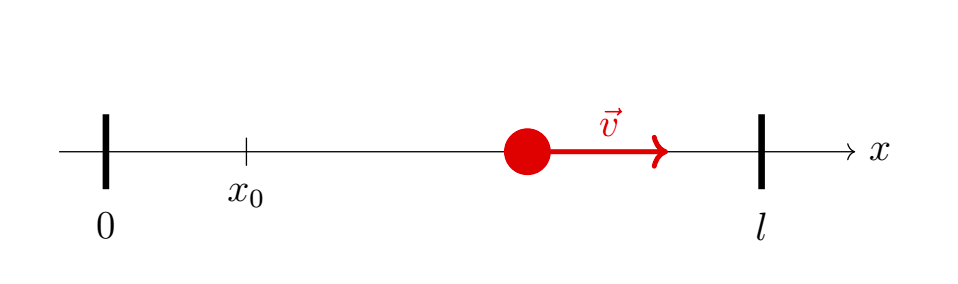
It does not matter how small the initial uncertainty is. A trillionth of a trillionth of a trillionth. For any nonzero uncertainty, there is always a future time at which the particle’s position becomes completely undetermined.
The only way to avoid this is to have zero uncertainty. This requires specifying the initial conditions with infinite precision, which means using a real number with all of its infinitely many digits physically determined.
So the idea that determinism is more than yet another impossible idealization is suspect at the very least.4
The lesson here is that no assumption, no matter how “obviously correct”, is sacred. It’s worth scrutinizing them all.
Realizing that Newton’s idea of absolute simultaneity does not make sense when you think it all the way through to its logical conclusion led to Special Relativity.
What breakthrough is waiting to be discovered once we take Poincaré’s observation on the impossibility of comparing time intervals seriously?
What would physics look like without real numbers? What if we take physics without determinism seriously from the start?
What if we take the idea that the present is “thick” seriously?
What if the existence of infinity turns out to be yet another impossible assumption?
What if the law of the excluded middle turns out to be yet another impossible idealization?
What revolution will be sparked when we undo the subject-object split?
This is, of course, the observation that, the year after Poincaré identified the issue in his book, Einstein would build Special Relativity on top of.
There is another fun nail in the coffin of Newton’s absolute time that Henri Poincaré discusses in The Value of Science. When we speak of physical events happening "at the same time," we unconsciously imagine a god-like intelligence surveying the whole universe and filing everything into one shared timeline. But Poincaré points out that this being could not have a perfect memory of the past, because if it did, all memories would be as vivid as the present moment, and there would be no distinction between past and present for it at all. There would, in short, be no time. So the very concept of a universal timeline depends on borrowing the perspective of a fictional, forgetful demigod, which is hardly solid ground for a definition. An entertaining book about this topic is The Rigor of Angels by William Egginton.
A great essay on this topic is Amanda Gefter’s How to Unsplit the World.
See Indeterminism, causality and information: Has physics ever been deterministic by Flavio Del Santo and Physics without Determinism: Alternative Interpretations of Classical Physics by Flavio Del Santo and Nicolas Gisin
Beautiful
Jakob
Thanks for this. Peering into the certainty concept allows us to realize it’s not there. I will check into those references at the end.